
The first harvest of new tea leaves took place on the 17th at Fukujuen Tea Learning Park in Kizugawa City, Kyoto Prefecture. This year, it was slightly earlier than the “88th night”, which traditionally marks the start of the new tea season.
Building on this early start, on the 23rd, the first tea harvest began in Nishinoomote City on Tanegashima Island, Kagoshima Prefecture. This harvest marks the start of the season in the prefecture – and in Japan. “The large temperature differences between day and night from autumn to winter resulted in uniformly sized tea leaves,” said producer Kenji Tanoue. A total of 180 kilograms of fresh leaves were harvested. According to the Tanegashima Tea Producers’ Association, this year’s harvest began three days earlier than last year. Association chairman Toyomi Shimojima commented, “The buds are uniform again this year, and we expect to produce high-quality tea if we proceed carefully. Kagoshima Prefecture has ranked first in Japan for crude tea production for the second consecutive year, and we hope to build on that momentum.” The first flush harvest is expected to continue until the end of April.
At the same time, structural changes in the industry are prompting companies to look beyond Japan’s borders. Marubeni Foods, announced on the 12th that it has entered into a business partnership with Vinati, a major Vietnamese tea manufacturer. By leveraging Marubeni Foods’ expertise in tea cultivation in Shizuoka Prefecture, the two companies will jointly develop tea for the Japanese market in Vietnam. As tea production in Japan declines due to an aging population and labor shortages, the goal is to produce green tea in Vietnam that suits Japanese tastes and export it to Japan. Vinati produces over 10,000 tons of tea annually and will adopt Marubeni Foods’ pesticide management and tea processing technologies to improve cultivation efficiency.
Meanwhile, beverage companies are responding to changing consumer needs and rising costs. Coca-Cola Japan announced two new “Ayataka” drinks for health-conscious consumers and summer hydration. “Ayataka Koi Hojicha,” a functional roasted green tea containing GABA to help reduce stress and fatigue, will be released on April 6. “Ayataka Mineral Green Tea,” a low-caffeine option with a lighter, less bitter taste, will launch on May 18. Amid rising tea leaf costs, the company is focusing on higher-value products. The hojicha uses 1.5 times more tea leaves for a richer flavor and targets consumers in their 30s and 40s. Both drinks will retail at 220 yen (excluding tax) for a 650ml bottle, matching the recent price increase of the standard Ayataka. A company representative stated the new products aim to deliver value that justifies the higher price.
In tea-producing regions themselves, diversification is also gaining attention. Iwata City in Shizuoka Prefecture, a major tea-producing region, is promoting lemon cultivation as a new local specialty to supplement farmers’ incomes. While there are calls for the prefecture to regain its top position in tea production, more farmers are exploring alternative revenue sources beyond tea. Iwata City, home to the Iwatabara Plateau – one of the prefecture’s leading tea-producing areas – has set “Becoming a Lemon-Producing Region” as a key strategy for fiscal year 2026 and plans to expand industry support from April.
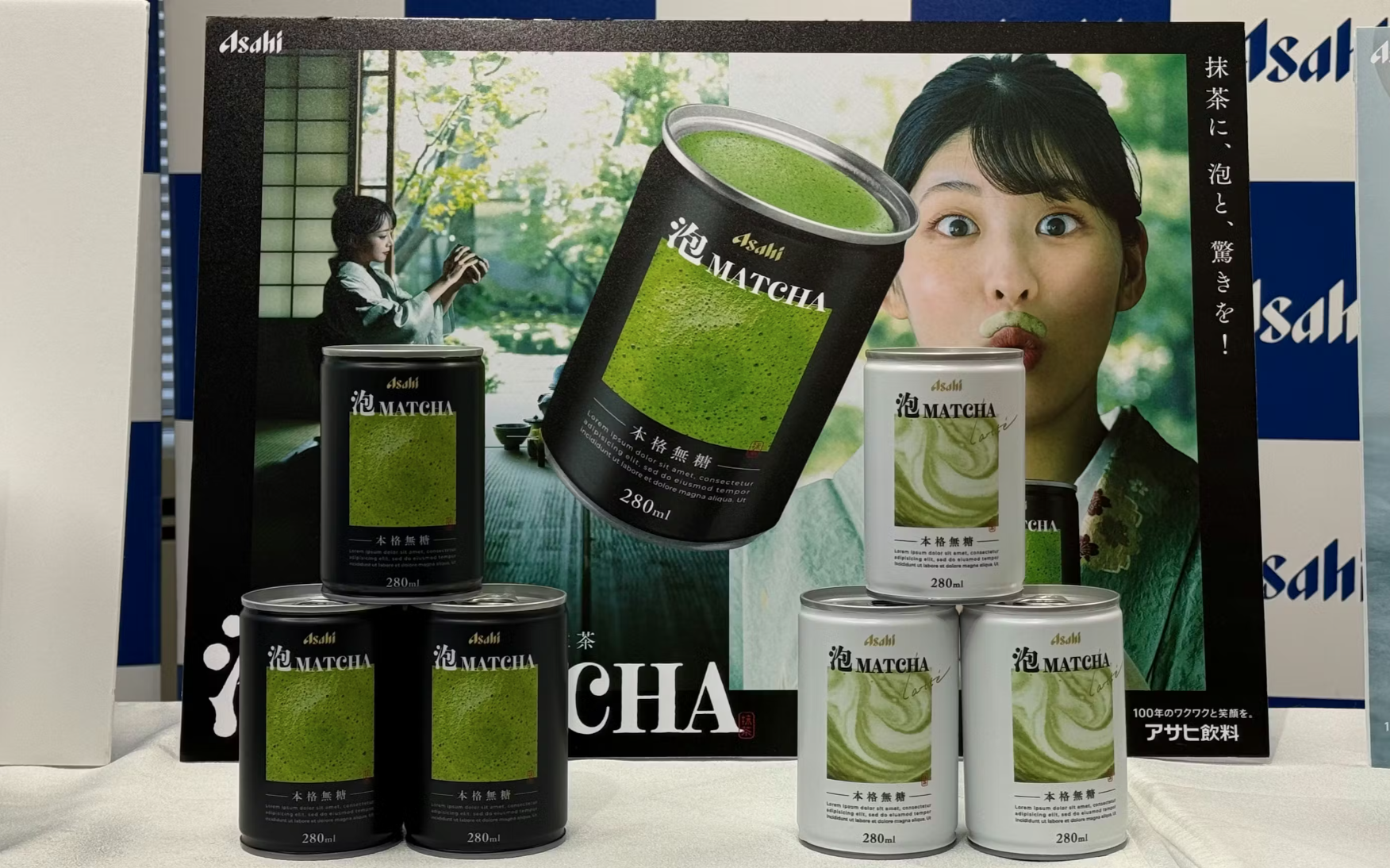
Product innovation continues alongside these regional efforts. Asahi Soft Drinks announced on the 12th that it will release a new matcha beverage, “Awa MATCHA,” in the second half of 2026. The product will feature a fully opening can lid designed to create a foamy matcha texture when opened. Made with domestically produced tea leaves, it has a mildly bitter flavour and will be available in two varieties: unsweetened and latte. The suggested retail price for a 280ml can is 302 yen.
At the community level, tea is also being used to promote education and local identity. Last month, elementary and junior high schools in Tenri City, Nara Prefecture, served “Nara Chameshi,” a local mixed rice dish made with “Satoyama Sannen Bancha,” a tea grown in the Fukuzumi district, as part of their school lunches. Following its 2024 “Organic Village Declaration,” the city has been promoting organic farming and using local produce in school meals. Fukuzumi, once a major Yamato tea-producing area, had fallen into disuse, but a 2022 revitalisation project restored abandoned fields to produce pesticide- and chemical-free tea, now branded as Satoyama Sannen Bancha. About 3,500 meals were served across 12 schools. “Nara Chameshi”, rice cooked with roasted soybeans and green tea, was adapted for school menus. The dish is believed to originate from temple cuisine at Todai-ji and Kofuku-ji. Officials hope the initiative encourages children to learn about and appreciate local ingredients.
Younger generations are also contributing fresh ideas to the industry’s future. Three second-year students from Showa Gakuin Shuei Junior and Senior High School (Chiba City) won a Special Jury Prize at the 5th High School Student Town Planning Contest finals in Tokyo on February 23. They proposed “Shimada Green Tea Tourism,” an inbound tourism project based on research conducted in Shimada City, Shizuoka Prefecture, which faces challenges such as an aging population. Their project was selected from 472 teams nationwide.
Finally, efforts to preserve and share tea culture are gaining momentum. The manga booklet The Story of Shoichi Kokushi of Shizuoka has been published. Supervised by Takashi Hanai, who has long been involved in regional development across Japan, the work introduces the life of Shoichi Kokushi – founder of Shizuoka tea – who brought tea seeds from Song China during the Kamakura period. To reach a global audience, editions have been produced in English, Chinese, and French, in addition to Japanese. Born in 1202 in present-day Aoi Ward, Shizuoka City, Shoichi Kokushi played a key role in introducing tea cultivation to the region. Although his grave and birthplace still remain, many local residents are unaware of their locations. Hanai believes that such overlooked history can serve as a “seed” for regional revitalization. By promoting these stories, regions can raise their profile and attract visitors. Drawing on years of experience, he emphasizes that people do not visit places they do not know – making local promotion essential. Promoting the legacy of Shoichi Kokushi, he says, is one example of this approach.
Image Source: Nikkei Shimbun
*The article is based on Japanese media articles:
“First harvest of new tea leaves” in southern Kyoto Prefecture at Fukujuen CHA Learning Park, Kyoto Shimbun 2026.03.17
“Perfectly budded”: 180 kg of first-flush tea leaves harvested in Nishinoomote, Kagoshima, Asahi Shimbun 2026.03.27
Marubeni Foods partners with major Vietnamese tea manufacturer to develop green tea for the Japanese market, Nikkei Shimbun 2026.03.12
Coca-Cola Japan to release “Strong Roasted Green Tea” in April , Nikkei Shimbun 2026.03.09
Shizuoka Prefecture’s Iwata City is supporting tea farmers in cultivating lemons to secure a new source of income, Nikkei Shimbun 2026.03.22
Asahi Soft Drinks to release a canned matcha beverage that fizzes when opened , Nikkei Shimbun 2026.03.12
“Nara Chameshi,” rice cooked with local tea, will be served in school lunches at elementary and junior high schools, Asahi Shimbun 2026.03.02
To revitalise tourism in Shimada City, Shizuoka Prefecture, through tea , Yomiuri Shimbun 2026.03.24
The legacy of the founder of tea: The “seed” of revitalisation , Yomiuri Shimbun 2026.03.22