
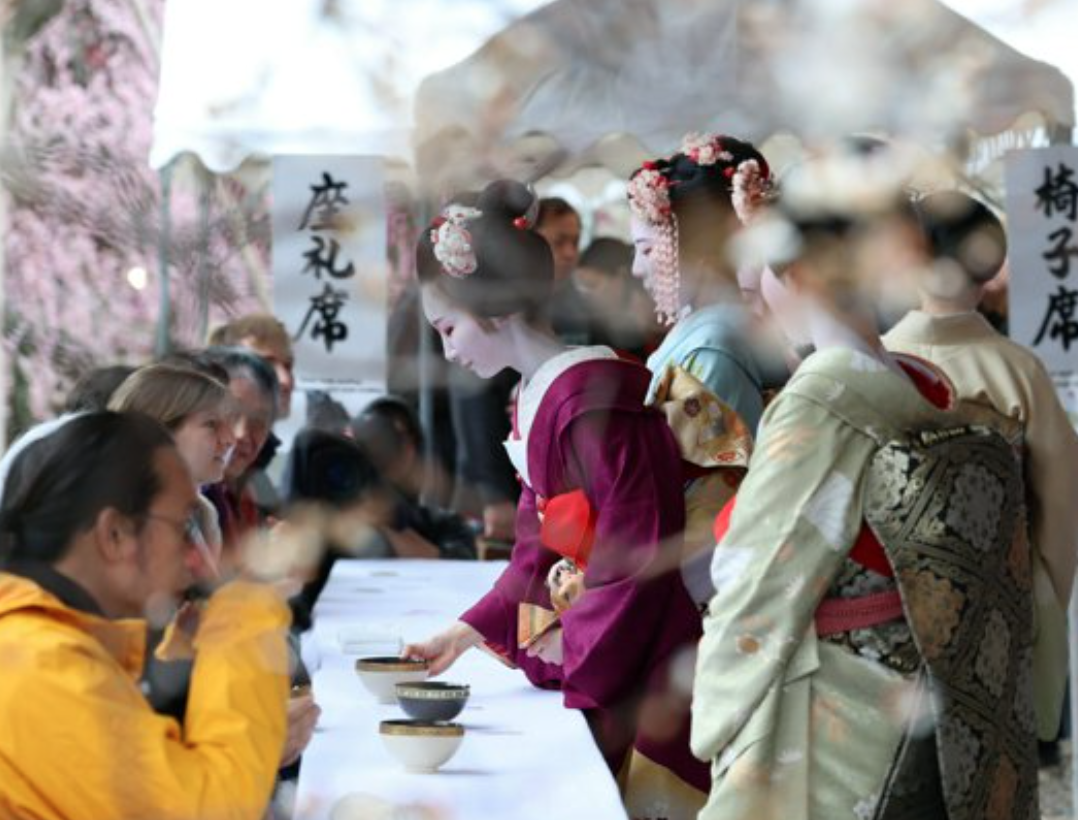
At Kitano Tenmangu Shrine in Kyoto, the annual Plum Blossom Festival honoured Sugawara no Michizane, the deity of learning, amid 1,500 blooming plum trees. Geisha and maiko performed in elegant kimono, and an outdoor tea ceremony recalled the historic Grand Tea Gathering first held there in 1587 by Toyotomi Hideyoshi, continuing a tradition more than nine centuries old.
Meanwhile, Japan’s tea sector faces mounting strain as tea plantations have shrunk by 29% over the past decade, while exports reached a record high in 2025 – highlighting the strain on production. As growers age and labor shortages worsen, more plantations are being abandoned, and the total harvesting area in major producing prefectures has fallen sharply compared to ten years ago. At the same time, the global matcha boom is rapidly expanding demand, pushing green tea exports to unprecedented levels. However, production is struggling to keep pace, creating supply shortages that are beginning to limit Japan’s agricultural exports and shift some demand to other countries.
Major beverage company Ito En has transferred its vending machine business, ending direct operation of its vending machines after rising green tea leaf costs forced price increases that drove consumers away, marking a significant shift for a sales channel long central to Japan’s drink market.
Shizuoka Prefecture ranked second in unrefined tea production for the second consecutive year, according to 2025 statistics released by Japan’s Ministry of Agriculture, Forestry and Fisheries on the 20th. Output of crude tea fell 7% from the previous year to 24,100 tons. Meanwhile, Kagoshima Prefecture, which claimed the top spot in 2024, increased production by 11% to 30,000 tons, widening the gap. The rise is attributed to farmers boosting yields through more frequent harvesting, encouraged by favorable prices even during the later picking season after the second flush.
A legal dispute involving Marukyu Koyamaen ended in settlement at the Osaka High Court after a wholesaler acknowledged that a Chinese supplier sold matcha under the brand name without authorization. Both parties agreed to work toward protecting the reputation of Uji matcha.
On a lighter note, thirty participants took part in the 69th chakabuki competition of the Ayabe City Tea Producers Association, in Ayabe, Kyoto. The event, a traditional tea-tasting contest, was held on the 7th at the JA Kyoto Ninokuni Tea Industry Center, where contestants tested their ability to distinguish teas from different regions using sight, aroma, and taste. Around 30 local tea producers joined the challenge, and Keiko Nakata won with a perfect score.
The Tea Industry Research Institute in Uji celebrated its 100th anniversary with a panel discussion held on the 26th at the Kyoto Prefectural Tea Research Institute. Farmers and professionals voiced both their future plans and their concerns about the lack of successors.
Finally, a historic memorial service took place in Kyoto city on the anniversary of the death of Sen no Rikyu, during which representatives of all three Sen schools of tea ceremony offered tea. The ceremony took place on 28th February at Daitokuji Temple, where the head temple of the Daitokuji branch of the Rinzai sect, marked the ritual “closing of the eyes” for the principal image and for a statue of Rikyu enshrined in the Kinmokaku Pavilion atop the Sanmon Gate. The memorial service is intended to continue the tradition of Sen no Rikyu (1522-1591), who perfected the wabi-cha style of tea ceremony.
February showed once again that from ceremony halls to tea fields, the story of tea keeps unfolding.
Image Source: Asahi Shimbun
*The article is based on Japanese media articles:
A plum blossom festival and a gorgeous tea ceremony featuring geisha and maiko at Kitano Tenmangu Shrine in Kyoto , Asahi Shimbun 2026.02.25
Tea plantations shrink by 29% in 10 years; exports hit record high in 2025, unable to keep up with boom, Nikkei Shimbun 2026.02.24
Ito En ends direct operation of vending machines as green tea prices more than double those in stores, driving consumers away, Nikkei Shimbun 2026.01.28
Shizuoka Prefecture ranks second in unrefined tea production for the second consecutive year, Nikkei Shimbun 2026.02.20
Kyoto-based company’s lawsuit over matcha sales in China reaches settlement in high court, Asahi Shimbun 2026.02.15
30 people take on chakabuki competition in Ayabe, Mainichi Shimbun 2026.02.08
The Tea Industry Research Institute in Uji celebrates its 100th anniversary, Kyoto Shimbun 2026.02.27
Historic memorial service on the anniversary of Sen no Rikyu’s death, Kyoto Shimbun 2026.02.25